Trading Psychology ·
Crypto Trading Psychology: Mechanical Rules to Override Your Emotions
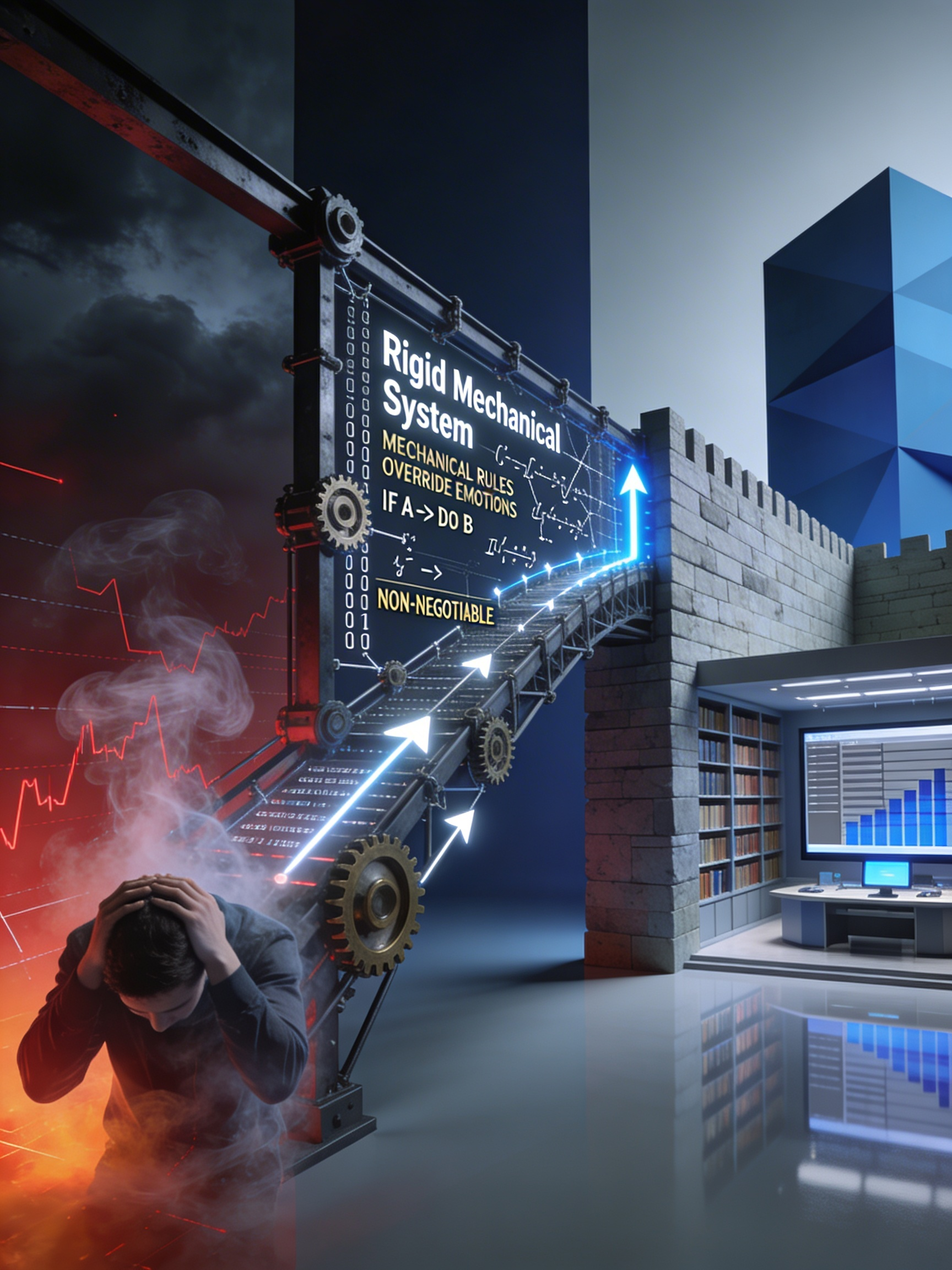
I have seen countless articles tell beginners to "just control your emotions." This is terrible, impractical advice. You cannot biologically turn off fear or greed when real money is on the line. Crypto trading psychology is not about becoming an emotionless robot; it is about building rigid, mechanical systems that strip your brain of decision-making power in moments of high stress.
When you are in a live trade, your IQ drops. The solution is to do all your thinking before you enter the market, and rely on non-negotiable rules once you are exposed.
Why "Just Control Your Emotions" is Terrible Advice We focus on the reality that willpower depletes. If you rely on willpower to close a losing trade, you will eventually fail. The market is specifically designed by institutional algorithms to trigger your panic and euphoria. To survive, you must replace emotional choices with binary rules. If 'A' happens, I do 'B'. There is no room for "maybe" or "let's wait and see."
Here are the exact mechanical rules you need to implement to fix the most common psychological traps.
The FOMO Fix: The "Limit-Order Only" Mandate FOMO (Fear Of Missing Out) occurs when you see a massive green candle and feel the desperate urge to jump in. The psychological fix is useless here; you need a mechanical barrier.
The Rule: Ban yourself from using "Market Execute" orders. You are only allowed to enter trades using Limit Orders at predetermined areas of liquidity or order blocks.
How it works: If a coin is pumping, you do not chase it. You identify where the price is likely to retrace (a support zone or Fair Value Gap) and set a limit order there. If the price never comes back to your order, you miss the trade. Accept it. Missing a trade costs you zero dollars; chasing a pump costs you your capital.
Eradicating Revenge Trading: Your Personal Circuit Breaker Revenge trading happens immediately after a loss. Your ego is bruised, and you immediately open a new, highly leveraged position to "win it back." This is how accounts are liquidated in minutes.
The Rule: Implement a "Hard Daily Drawdown Limit" and a "Cool-Off Timer."
How it works: Set a rule that if you lose 2% of your total account equity in a single day, or if you lose two trades in a row, your trading day is over. Period. You must physically close your charting software and step away from your desk for 24 hours. Professional platforms allow you to lock yourself out. Use this feature.
Defeating Loss Aversion with Time-Based Stops Traders naturally want to hold losing positions, hoping they will bounce back, because realizing a loss causes psychological pain. Most traders know to use a price-based Stop-Loss, but professionals use something else to kill this hope.
The Rule: The Time-Based Stop.
How it works: If you enter a trade expecting a breakout, and the asset just chops sideways for 12 hours doing nothing, the setup is invalid. Your capital is trapped in a dead asset while other opportunities pass. Set a rule: "If my trade is not in profit within 'X' amount of time (e.g., 4 hours for a day trade), I close it manually, regardless of price."
The 3-Point Journaling Framework the Pros Use A trading journal is not a diary; it is a data-collection tool for your psychological flaws. When you log a trade, you must include three specific data points alongside the financial metrics:
- Confluence: List the exact 3 technical reasons you entered. (If you can't list 3, it was an emotional trade).
- Emotional State (1-10): Rate your anxiety level when entering. If you are above a 6, your position size is too big. Reduce your leverage immediately.
- Mistake Categorization: If you lost, was it a "System Failure" (you followed rules, but the market reversed) or a "Discipline Failure" (you broke your rules)? You can survive system failures; you cannot survive discipline failures.