Market Analysis ·
How to Manage Trading Drawdown Without Losing Control
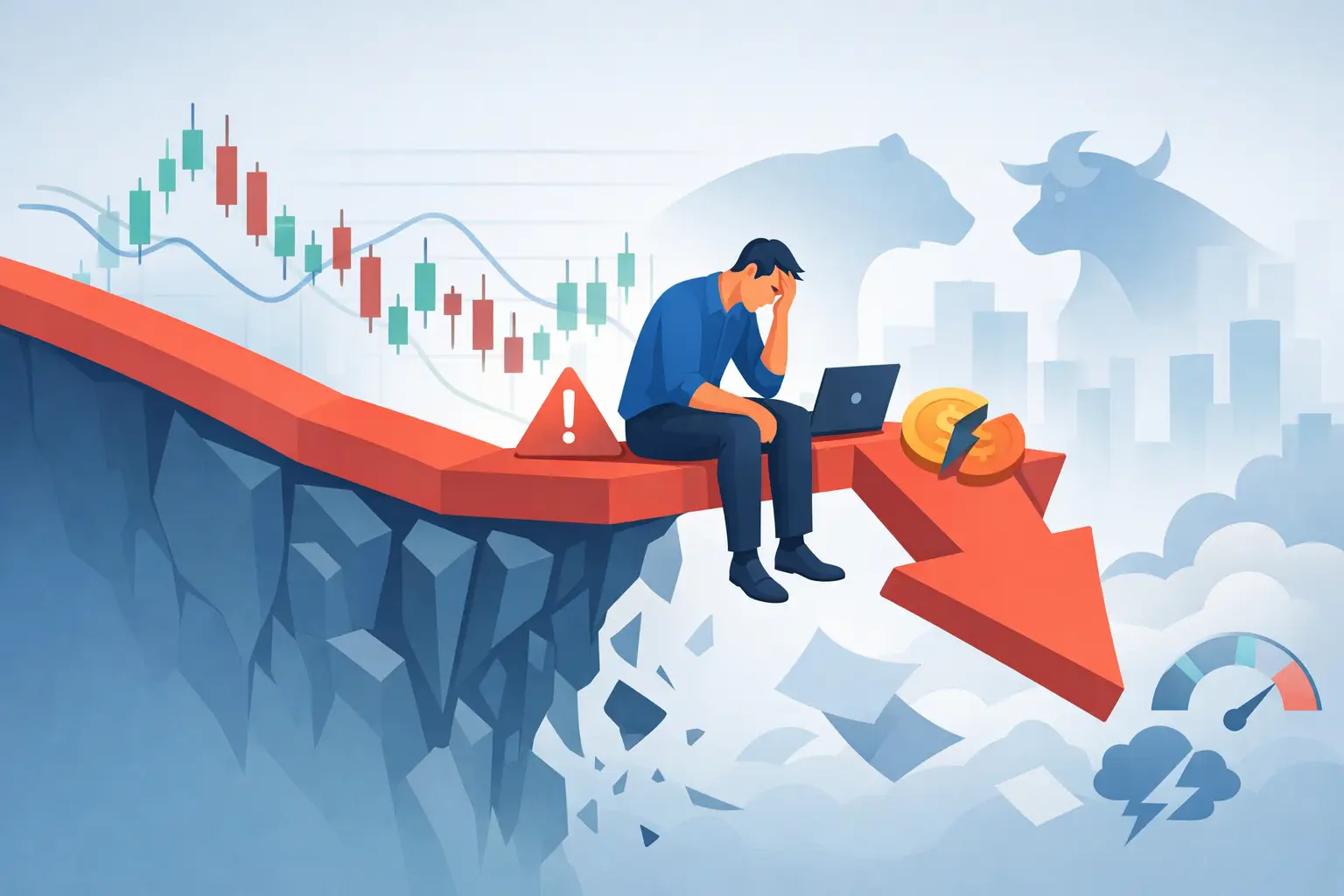
A drawdown is where a trading model faces its real examination. Anyone can follow a plan after three clean wins. The harder test is whether you can manage trading drawdown when BTC reverses from a liquidity sweep, an expected order block fails to hold, and your confidence begins to interfere with execution.
For crypto traders, drawdowns are not automatically proof that a strategy is broken. They are a normal cost of operating a probabilistic model in a volatile market. The danger is not the losing streak itself. The danger is allowing a temporary performance decline to change your risk, bias, setup criteria, or behavior without evidence.
A controlled response protects both capital and decision quality. That is the objective.
Define Drawdown Before You Try to Fix It
Drawdown is the decline from the highest point of your trading equity curve to its subsequent low. If an account grows from $10,000 to $11,000, then declines to $10,450, the drawdown is $550, or 5% from the equity peak.
This distinction matters because traders often measure losses emotionally rather than structurally. Two consecutive losing trades can feel severe after a winning period, even if the account is only down 1%. Conversely, a 12% drawdown can be minimized because it accumulated slowly across dozens of low-quality decisions.
Track drawdown in both dollars and percentage terms. Dollar figures show the immediate financial impact. Percentages show whether risk is becoming disproportionate to the account size. A 5% decline requires roughly a 5.3% recovery. A 20% decline requires 25%. The deeper the drawdown, the more difficult recovery becomes because the remaining capital base is smaller.
Your first task is to establish three thresholds: a normal drawdown range, a caution threshold, and a maximum allowable drawdown. These numbers should be set before the next losing trade, not negotiated while you are frustrated.
Separate Normal Variance From Model Failure
A high-quality SMC or ICT-based model will still produce losses. Price can raid external liquidity, displace through an imbalance, and then fail to return to the fair value gap you anticipated. A valid setup can lose because no setup provides certainty.
The question is not, “Did I lose?” It is, “Did I execute a qualified setup according to the model?”
A normal drawdown generally has clear characteristics. Trades meet your entry conditions, risk remains fixed, and losses occur within the expected historical distribution of your setup. For example, if your backtested model has a 45% win rate with an average 2R winner, four losses in a row may be uncomfortable but statistically possible.
Model failure looks different. It appears when the market environment changes, when repeated trades violate the same assumption, or when your journal shows that performance has deteriorated across a meaningful sample of valid setups. A bearish market structure model may underperform during a persistent short squeeze. A lower-time-frame order block entry may become unreliable when volatility expands around major macro events.
Do not diagnose a model after three trades. At the same time, do not hide behind “variance” when your execution journal shows persistent rule breaks. The evidence determines the response.
How to Manage Trading Drawdown With Fixed Risk
The fastest way to turn a manageable drawdown into account-threatening damage is to increase position size in an attempt to recover. This is revenge trading dressed up as confidence.
Risk should be expressed as a fixed percentage or fixed dollar amount per trade. For many developing traders, risking 0.25% to 1% of account equity per position provides enough room to survive variance while keeping emotional pressure contained. The appropriate number depends on your setup frequency, win rate, average reward-to-risk profile, and maximum drawdown tolerance.
If your standard risk is 1%, do not move to 2% because you are down 4%. The market has not become more predictable because your account is lower. In fact, your decision-making is more likely to be compromised.
A planned reduction in risk is different. When your caution threshold is reached, reducing risk from 1% to 0.5% can preserve capital while you assess conditions. This is not fear. It is a circuit breaker. You remain engaged with the market, collect data, and avoid making a large recovery requirement worse.
Set a daily loss limit as well. Once reached, stop opening new positions for that session. Crypto trades around the clock, which makes this boundary especially important. Constant access creates the illusion that every loss can be repaired immediately. Usually, it cannot.
Audit Execution, Not Just P&L
A drawdown review should start with screenshots, annotations, and trade data, not feelings. For each loss, document the higher-time-frame bias, liquidity target, market structure shift, displacement, entry location, stop placement, and intended target.
Then classify the trade. Was it a valid loss, an early entry, a missed confirmation, an oversized position, a trade taken outside your session, or a setup that did not meet your model at all? This process reveals whether the drawdown is coming from the strategy or from execution drift.
Review the Market Context
[SMC and ICT methodology](https://cryptoanalysislab.com/insights) depend on context. An order block is not a signal simply because price touched it. Its quality depends on location, surrounding liquidity, displacement, time frame alignment, and whether price has already delivered the expected move.
Review whether you were trading into opposing higher-time-frame liquidity, fading strong displacement, or forcing entries during range conditions. A setup that performs well after a sweep of sell-side liquidity and bullish market structure shift may perform poorly when taken in the middle of a dealing range.
Review Your Rule Adherence
Score every trade against your rules. A simple yes-or-no checklist is enough: Was the bias defined? Was liquidity taken? Was there confirmed displacement? Did the entry occur at a preplanned PD array? Was risk within limits?
If most losses were rule-compliant, the model may simply be in a normal losing sequence. If the losses are mostly noncompliant, the solution is not a new strategy. It is tighter execution discipline.
Reduce Inputs During a Drawdown
When performance drops, many traders add indicators, follow more social media accounts, or jump between time frames looking for certainty. This expands noise precisely when your process needs to become more controlled.
Instead, narrow your operating environment. Trade one or two markets. Focus on your highest-quality session. Take only the A-grade setup that has clear confluence with your market structure framework. If your model is built around liquidity raids and displacement, do not suddenly trade breakout candles in the middle of Asia because you feel behind.
This is where a structured execution framework has practical value. Tools such as Crypto Analysis Lab's Antidote AI execution engine can support consistency, but they should reinforce a defined model rather than replace judgment. Technology can help standardize process. It cannot make an undisciplined risk decision safe.
Build a Recovery Plan That Does Not Depend on Winning Quickly
The goal after a drawdown is not to get back to breakeven by Friday. The goal is to resume correct execution over a sufficient sample size. Recovery is an outcome of process, not a trade idea.
Create a specific protocol for your caution threshold. Reduce risk, limit the number of trades per day, and review every completed position before placing the next one. At your maximum drawdown threshold, pause live trading or move to simulation until you can identify the source of the decline.
This is not always necessary after every losing streak. A trader with a thoroughly tested model and clean execution may continue at normal size through a modest drawdown. A newer trader with inconsistent records should be more conservative. It depends on the quality of your data and your demonstrated ability to follow rules under pressure.
Avoid changing several variables at once. If you reduce risk, change your entry model, switch assets, and trade a different session simultaneously, you will not know what caused the next result. Adjust one variable, document it, and evaluate it over a meaningful number of trades.
Protect Your Decision-Making Capacity
Drawdown management is partly mathematical and partly behavioral. Fatigue, urgency, and frustration can make a structurally valid trade look like a recovery opportunity. That is when traders move stops, skip confirmations, and overtrade.
Use deliberate separation between trades. After a loss, record the trade before looking for the next entry. After a daily loss limit, leave the charts. The market will provide another setup. Your capital and focus are finite resources.
A professional trader does not need to prove that every idea was right. They need to preserve enough capital and clarity to execute the next valid opportunity with the same discipline as the first. Treat drawdown as a process test, and your response to it can become one of the strongest edges in your trading plan.