Market Analysis ·
How to Overcome FOMO in Trading: The Mechanical Risk Management Guide
I have analyzed thousands of liquidated retail accounts, reviewed endless trade logs, and the data tells a consistent, brutal story. Traders rarely blow up their equity because their technical analysis is inherently flawed. They do not fail because they misread a support level, misunderstood a trendline, or failed to identify a moving average crossover. They fail because they simply cannot control their own brains. When real capital is on the line and adrenaline floods the nervous system, logical analysis evaporates completely.
If you are researching how to overcome FOMO in trading, you must first accept a harsh, uncompromising reality. FOMO (Fear of Missing Out) is not merely a fleeting human emotion or a minor character flaw that you can brush off. In the financial markets, FOMO is a systematic failure. It is a highly destructive technical account killer. It is the direct result of operating without a rigid, mechanical process. When you lack a mathematical framework to guide your entries and exits, you are forced to rely on willpower—and in the highly volatile, 24/7 cryptocurrency markets, willpower always depletes.
There is a well-known industry statistic: 90% of retail traders lose 90% of their capital within their first 90 days. This happens because the market is designed to extract wealth from the undisciplined and transfer it to the mechanical. To survive the relentless volatility of the crypto market, a profound paradigm shift is required. You must stop viewing yourself as a subjective speculator attempting to guess the next massive altcoin pump based on social media hype.
Instead, you must rebuild your psychology from the ground up to operate as a cold, calculating "Execution Engine." An Execution Engine does not feel excitement during a massive breakout, nor does it feel panic during a severe drawdown. It does not read Twitter to validate its bias. It simply processes chart data, calculates risk mathematically, and executes predefined rules without hesitation.
The Psychology of FOMO: Why Traders Chase the Market
Traders chase massive green candles because they are biologically wired to do so. Our brains are evolutionarily designed to seek immediate rewards and avoid immediate pain, making us highly susceptible to dopamine addiction. When you observe a token violently surging 20% on the 5-minute chart, your amygdala—the fear, survival, and emotional center of your brain—completely hijacks your logical prefrontal cortex. It overrides your trading plan and convinces you that this specific move is a once-in-a-lifetime wealth opportunity. The pain of sitting on the sidelines while others seemingly get rich becomes unbearable.
I have seen the exact anatomy of a "Chased Trade" play out identically across every single market cycle, from Bitcoin's early days to the latest memecoin craze. It follows a highly predictable, devastating loop.
It begins when the price of an asset unexpectedly surges, often breaking a minor resistance level. The retail trader, who is currently flat (holding no position) and sitting on the sidelines, feels a sharp spike in dopamine mixed with intense financial anxiety. They watch the asset climb 5%, then 10%, then 15%. They see influencers posting screenshots of massive gains. They completely abandon their original, carefully crafted trading plan because the emotional pain of missing the move overrides their logic.
In a state of sheer panic, the trader hits the market "buy" button. They enter the asset at the absolute local top, completely ignoring market structure, premium pricing, and logical invalidation points. What they do not realize is that the massive green candle they just bought was engineered by institutional players specifically to attract retail liquidity. The moment retail FOMO peaks and the masses are aggressively buying, Smart Money begins aggressively distributing (selling) their accumulated holdings to lock in profit.
The momentum instantly dies. The market violently reverses, forming a massive bearish engulfing candle. The retail trader, who bought the absolute peak with no planned Stop Loss, is now trapped in a freefall. Paralyzed by fear, they hold onto the losing position, hoping it will bounce back. Instead, the price continues to bleed. Eventually, panic selling ensues, or the exchange forcefully liquidates the position. The retail account is systematically destroyed. This devastating loop will repeat endlessly until you fundamentally understand that in crypto day trading, human emotions must end precisely where strict, unbendable rules begin.
The Antidote: Core Risk Management Rules for Crypto Day Trading
You cannot out-meditate, out-think, or out-willpower the market. The market is an indifferent algorithm that does not care about your financial goals or your emotional state. The only true, permanent cure for FOMO is an operational framework that completely removes subjective decision-making from the equation. We achieve this by establishing and enforcing non-negotiable risk management rules for crypto day trading.
The absolute, undisputed foundation of this mechanical framework is universally known as "The 1 Percent Rule." However, despite its popularity, I consistently see intermediate and beginner traders fundamentally misunderstand how this rule is applied in practice. To trade professionally, you must comprehend the absolute mathematical difference between *Account Risk* and *Position Size*. This specific distinction is the dividing line between consistent profitability and eventual bankruptcy.
Account Risk is the exact, fixed amount of capital you are mathematically prepared to lose if your trade idea is proven wrong and your Stop Loss is triggered. If you manage a $10,000 trading portfolio, risking 1% means your maximum allowable loss for a single, isolated setup is exactly $100. This is your survival metric.
Why 1%? It comes down to the mathematics of drawdowns. If you lose 10% of your account, you need an 11% gain to recover. But if you trade emotionally, risk too much, and lose 50% of your account, you do not need a 50% gain to get back to breakeven—you need a 100% gain just to recover your initial capital. By capping your absolute loss at 1% per trade, you mathematically guarantee that you can endure a brutal, highly improbable 10-trade losing streak and still retain 90% of your total trading capital. You stay in the game.
Position Size, on the other hand, is the nominal monetary value of the asset you are purchasing. Your Position Size is *not* your Account Risk. You do not simply open a trade with $100 and use maximum leverage. Depending on where your logical Stop Loss is located on the chart, your actual Position Size might be $2,000, $5,000, or even your entire $10,000 account balance. The key is that your Stop Loss is placed so precisely that if the market drops, invalidates your setup, and closes that massive position, the actual cash removed from your account balance is exactly that predefined $100 risk allowance.
Eliminating Emotion with a Crypto Position Sizing Calculator
Math takes the brain out of speculation. If you calculate your exact trade size mathematically before your finger ever touches the execution button, the paralyzing fear of liquidating your account disappears entirely. When you know, with absolute certainty, that the worst possible outcome is a controlled 1% loss, FOMO loses its grip. You are no longer gambling; you are operating a statistical business.
To transition into a true mechanical Execution Engine, you must permanently stop guessing your leverage sliders and randomly choosing lot sizes based on how "confident" you feel about a setup. You must rely exclusively on a crypto position sizing calculator. This methodology is driven by one absolute, unchangeable position sizing formula:
> Position Size = (Account Balance × Risk Percent) ÷ Distance to Stop Loss
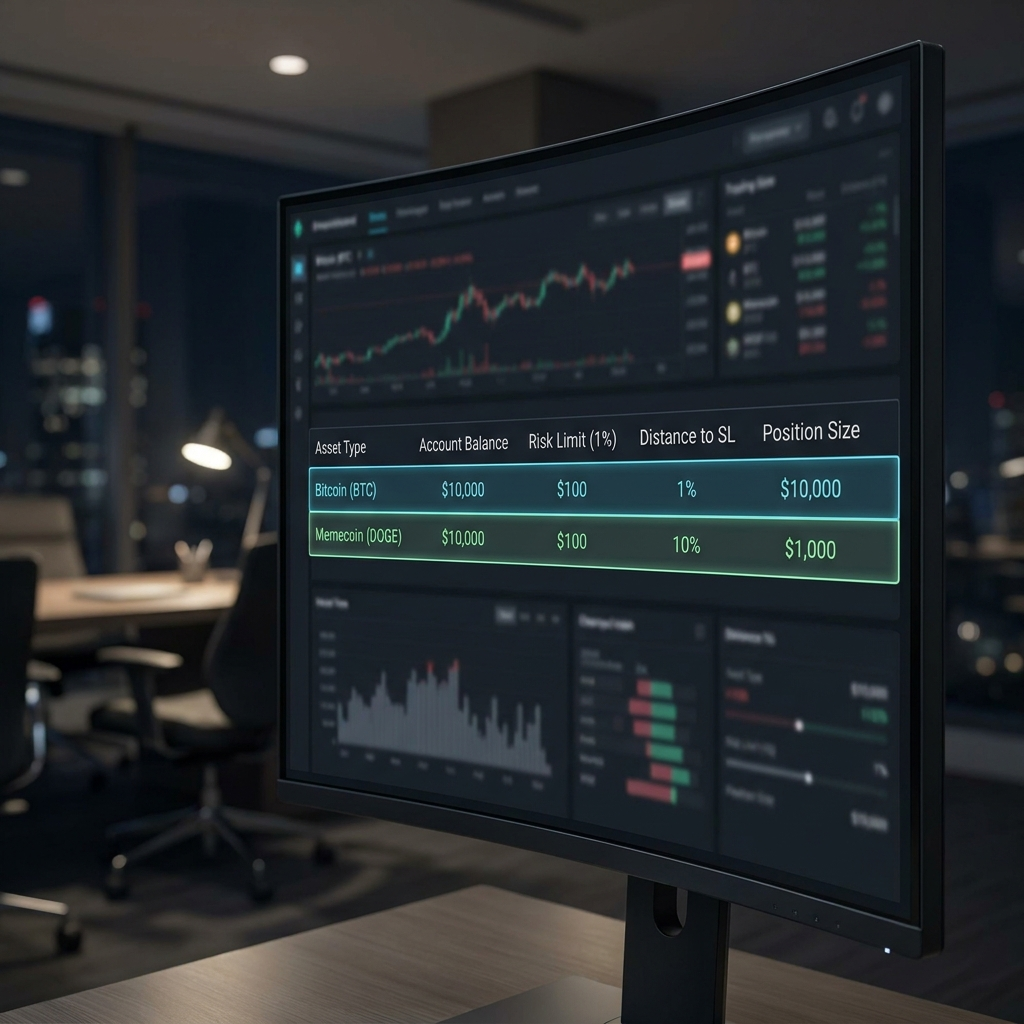
To fully grasp how this mathematical formula protects your capital across completely different, highly volatile market conditions, review the structured comparative examples below. We will use the exact same $10,000 account, risking the exact same 1% ($100), across three wildly different crypto assets.
Comparative Example: The 1% Rule in Action
Scenario A: Bitcoin (BTC) - Low Volatility Setup
- **Account Balance:** $10,000
- **Risk Limit (1%):** $100
- **Distance to Stop Loss:** 1% (A tight Stop Loss placed just below a clear 15-minute Order Block)
- **Calculated Position Size:** $10,000 (You deploy your full capital)
- **Max Loss if Hit:** **$100**
Scenario B: Mid-Cap Altcoin (e.g., SOL or AVAX) - Medium Volatility Setup
- **Account Balance:** $10,000
- **Risk Limit (1%):** $100
- **Distance to Stop Loss:** 5% (A wider Stop Loss needed to survive normal intraday fluctuations)
- **Calculated Position Size:** $2,000 (You deploy only a fraction of your capital)
- **Max Loss if Hit:** **$100**
Scenario C: Memecoin (e.g., DOGE or PEPE) - Extreme Volatility Setup
- **Account Balance:** $10,000
- **Risk Limit (1%):** $100
- **Distance to Stop Loss:** 10% (A very wide Stop Loss required to avoid being hunted by erratic wicks)
- **Calculated Position Size:** $1,000 (You deploy a very small fraction of your capital)
- **Max Loss if Hit:** **$100**
Notice the incredible mathematical safety net at work here. Because Bitcoin currently offers a high-probability, low-volatility setup, you can place a tight 1% Stop Loss without fear of being stopped out by random noise. The formula allows you to deploy your entire $10,000 capital safely.
Conversely, the Memecoin is highly erratic. If you deployed your full $10,000 into a Memecoin and it dropped 10%, you would lose $1,000 (10% of your account) in a single trade—a catastrophic error. To compensate for that massive 10% invalidation distance, the formula aggressively shrinks your allowable Position Size down to just $1,000.
Mathematics completely neutralizes the asset's inherent volatility. Whether you are trading blue-chip Bitcoin, a mid-cap altcoin, or a chaotic, hype-driven memecoin, your absolute worst-case scenario is mathematically identical: you lose exactly $100. The fear is gone because the risk is normalized.
FAQ: Crypto Position Sizing & Leverage
Before executing this mathematical framework on live charts, we must systematically address and destroy the most dangerous misconceptions retail traders hold regarding margin, sizing, and risk.
Q: Does using high leverage change my position size or increase my risk? A: Absolutely not. Leverage is strictly a capital-efficiency tool; it is not a tool to multiply your risk. Whether you use 1x leverage, 10x leverage, or 50x leverage, your calculated position size (e.g., $1,000 for the memecoin) and your total monetary risk ($100) must remain completely identical. High leverage simply allows you to put up less of your own margin as collateral to control that exact same position size, freeing up the rest of your capital for other setups. If increasing your leverage increases your risk, you are gambling, not calculating.
Q: How often should I calculate my position size? A: You must run the formula before every single trade you execute. Markets are living, breathing algorithms. Volatility shifts constantly, and your logical invalidation distance (the percentage between your entry and your Stop Loss) will never be mathematically identical from one setup to the next. You must never guess your lot size or reuse the exact same position size from yesterday's trade.
Q: Can I risk 2% or 3% if I feel incredibly confident about a trade setup? A: No. The market does not care about your confidence levels. High-probability setups fail all the time due to unforeseen macroeconomic news, sudden liquidity sweeps, or algorithmic anomalies. Confidence is an emotion, and as an Execution Engine, you do not trade on emotion. Sticking strictly to 1% protects you from the arrogance that inevitably leads to account blow-ups.
Step-by-Step Execution Checklist for Your Trading Constitution
You cannot simply read an article about this mechanical framework, nod your head, and expect your psychology to magically change. You must rigorously, ruthlessly enforce it. Before you are permitted to open any trade on any exchange, you must run through a hardcoded, copy-pasteable mechanical checklist.
If you answer "no", if you hesitate, or if you try to justify bending the rules on any of these parameters, the trade is illegal. You must close the chart and walk away.
- **Is the higher timeframe market structure aligned with my trade direction?** (Yes/No)
- **Has the market recently swept a major liquidity pool to trap retail traders?** (Yes/No)
- **What is my exact logical invalidation point (Stop Loss) based on chart structure, before I even consider an entry?**
- **Did I run the exact numbers through the position sizing formula based on that specific Stop Loss distance?**
- **Am I risking exactly 1% (or strictly less) of my total account equity?**
This strict, uncompromising mathematical framework serves as the foundational chapter of your true trader's constitution. A constitution replaces the need for willpower. It dictates your actions, governs your capital, and ensures your emotions cannot access your portfolio.
Discipline is not an inherent personality trait that you are simply born with; it is an operational standard that is automated through proven frameworks. If you are truly ready to permanently eliminate emotional trading, stop bleeding your hard-earned capital to FOMO, and automate your execution matrix, you must take the next step.
Stop funding the institutions with your mistakes, build your mechanical system, and finally protect your capital.