Market Analysis ·
What Is Liquidity Sweep in Crypto Trading?
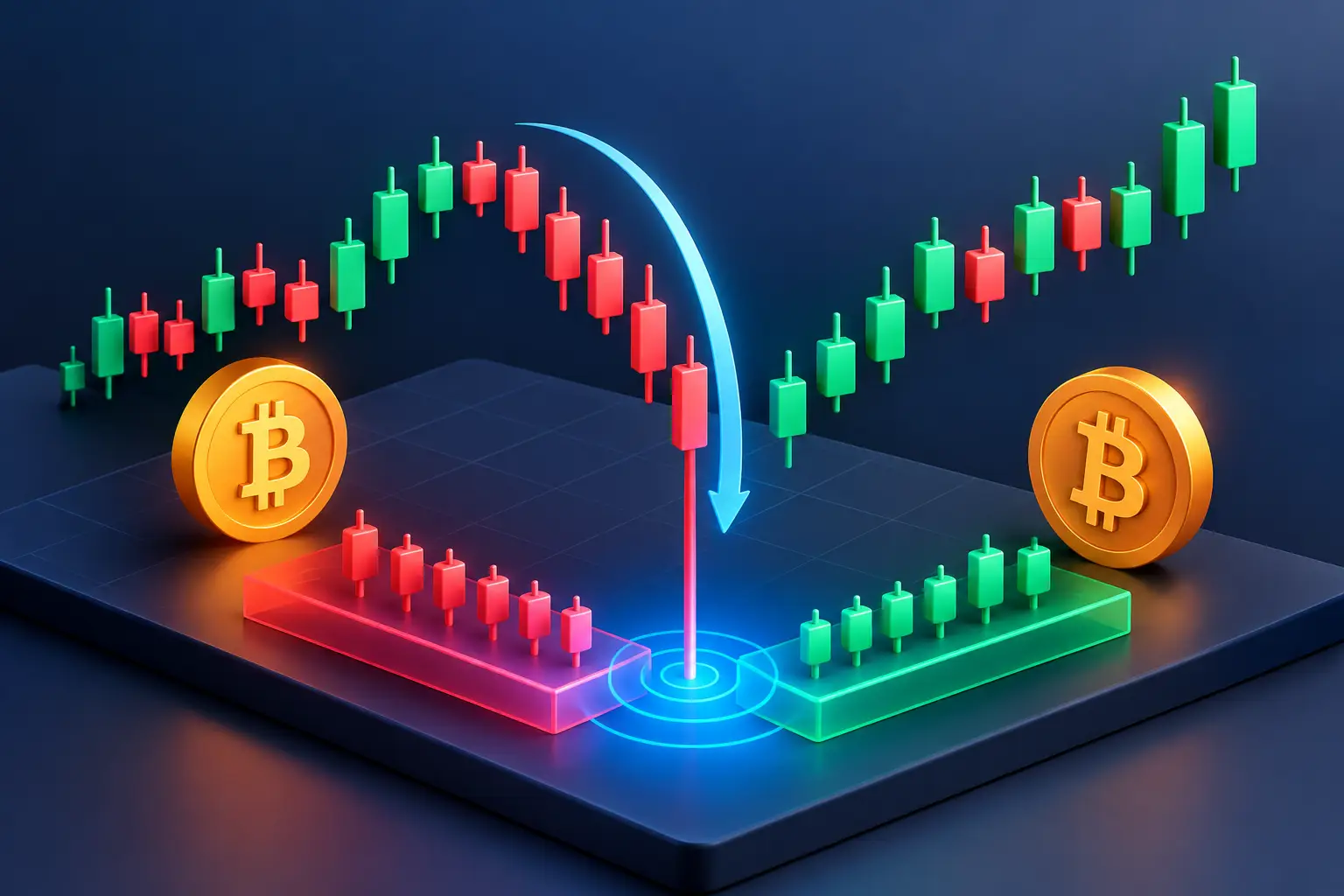
A sharp move through an obvious high or low often looks like a breakout to the untrained trader. In many cases, it is a liquidity event. Understanding what is liquidity sweep changes how you read that move: rather than chasing price after it takes a level, you assess whether price has collected orders to fuel a reversal or to support further delivery.
In Smart Money Concepts and ICT methodology, liquidity is not an abstract theory. It is the pool of resting orders available around predictable price points. A liquidity sweep occurs when price trades through one of those pools, triggering stop-losses and breakout entries before revealing whether the market intends to reverse or continue.
What Is a Liquidity Sweep?
A liquidity sweep is a deliberate-looking price movement beyond a prior high, prior low, equal highs, equal lows, or a clear range boundary where stop orders are likely concentrated. When price reaches that area, sell stops below lows or buy stops above highs become market orders. That creates the immediate order flow needed for larger participants to transact efficiently.
For example, imagine Bitcoin forms two nearly equal highs below a resistance level. Many short sellers place stops above those highs, while breakout traders place buy orders there. If price rallies through the highs, it can trigger both groups at once. That run on buy-side liquidity may be followed by aggressive selling and a bearish reversal, or it may simply be the first stage of a genuine upside expansion.
The sweep itself is not a trading signal. It is a location and event. The trader’s edge comes from reading what price does after liquidity is taken.
Why Liquidity Sits Above Highs and Below Lows
Markets attract orders at obvious reference points because retail risk management and breakout logic are naturally clustered. Traders frequently hide stops above swing highs when short and below swing lows when long. They also enter breakouts when a visible boundary gives way.
Common liquidity pools include:
- Equal highs and equal lows
- Previous day, week, or session highs and lows
- Swing highs and swing lows
- Range highs and range lows
- Trendline touches and obvious chart patterns
- Round numbers and major psychological prices
Not every high or low carries the same weight. A high formed during a higher-timeframe consolidation, near a premium or discount zone, and aligned with a major session level is generally more meaningful than a random five-minute pivot in the middle of a range. Context determines whether the liquidity is likely to matter.
Liquidity Sweep vs. Liquidity Grab vs. Breakout
These terms are often used interchangeably, but precision improves execution.
A liquidity sweep usually describes price taking a meaningful external high or low. It can extend beyond the level by a few ticks or travel substantially farther. The defining feature is the removal of a visible liquidity pool.
A liquidity grab is often used for a smaller, faster raid into nearby internal liquidity. For instance, price may briefly take a minor low inside a dealing range before continuing toward a larger target. The terminology varies among traders, so focus on the structure rather than arguing over labels.
A breakout is not automatically a sweep. If price trades above resistance, holds above it, builds acceptance, and continues to print bullish displacement, the move may be a valid continuation. Calling every breakout manipulation is just as damaging as chasing every breakout blindly.
The difference is confirmed by subsequent delivery. Does price reject the level, displace in the opposite direction, and break market structure? Or does it consolidate above the level and continue higher? That is the question that matters.
How to Read a Liquidity Sweep With Market Structure
A disciplined SMC analysis begins before price reaches the liquidity pool. First establish higher-timeframe direction. If the four-hour or daily structure is bullish, sell-side liquidity below a short-term low may be a logical draw before price continues upward. If the broader structure is bearish, a run above local highs may provide the premium pricing needed for a short setup.
Next, identify the dealing range and determine where price sits within it. In ICT methodology, traders often view the lower half of a range as discount and the upper half as premium. A sell-side sweep in discount, followed by bullish displacement, is generally more compelling than attempting to short that same low simply because it broke.
Then wait for confirmation after the sweep. A high-quality reversal sequence commonly has three components: liquidity is taken, price shows decisive displacement away from the level, and lower-timeframe market structure shifts in the new direction. The displacement may leave a fair value gap or reveal an order block that can become a retracement entry zone.
The order matters. Entering before the sweep assumes the market will respect an obvious level. Waiting for price to take liquidity and confirm its intended direction places the trader on the side of demonstrated order flow.
A Bearish Sweep Scenario
Suppose Ethereum is trending lower on the one-hour chart. Price rallies into a prior bearish order block and reaches equal highs formed during the London session. That area contains buy-side liquidity. During New York volatility, price trades above the equal highs, triggers stops, then closes back below them with strong bearish candles.
The sweep alone does not justify a short. The stronger setup emerges if price breaks a recent higher low on the lower timeframe, creating a bearish market structure shift. A retracement into the displacement leg, fair value gap, or newly formed bearish order block can offer a defined entry. The stop belongs beyond the sweep high, where the short thesis is invalidated. A reasonable target may be sell-side liquidity below a prior low.
A Bullish Sweep Scenario
Now reverse the conditions. Bitcoin holds a bullish higher-timeframe structure but retraces into discount. Price trades below equal lows, takes sell-side liquidity, and rapidly reclaims the level with impulsive bullish displacement. If it breaks a nearby lower high and then retraces into a bullish imbalance, the setup may favor continuation toward buy-side liquidity.
This framework prevents a common mistake: selling into a sell-side sweep because the candle looks bearish. A stop run below a low can be the mechanism that launches the next bullish leg.
Timeframe and Session Context Matter
Liquidity exists on every timeframe, but its relevance changes. A one-minute sweep can be useful for execution, yet it should not override a four-hour draw on liquidity. Higher timeframes establish the narrative; lower timeframes refine entries and risk.
Crypto trades around the clock, but liquidity and volatility still concentrate around major global trading sessions and macroeconomic releases. A sweep during thin weekend conditions may be less reliable than one occurring during active U.S. market hours. That does not mean weekend setups cannot work. It means the trader should expect more erratic delivery, wider relative swings, and a greater need for confirmation.
Avoid treating session timing as a rigid rule. Use it as a contextual filter alongside structure, location, and displacement.
How to Trade Liquidity Sweeps Without Chasing Them
The practical goal is not to predict every stop hunt. It is to build a repeatable process that limits impulsive decisions.
Start by marking obvious external liquidity on the higher timeframe. Then define the likely directional draw based on market structure and premium-discount location. As price approaches a level, move to your execution timeframe and wait for the sweep to occur.
After the raid, require evidence. That may be a market structure shift, a clear displacement candle, and a retracement into a fair value gap or order block. Not every setup will provide a clean retracement. Missing a move is preferable to entering after expansion with poor risk-to-reward.
Risk management is non-negotiable. A stop should sit beyond the point that invalidates the setup, not at an arbitrary dollar amount. Position size must then be adjusted so the loss remains within your fixed risk limit. If the invalidation point is too far away, reduce size or pass on the trade. A liquidity concept does not improve an oversized position.
Common Errors Traders Make
The first error is assuming every swept high or low must reverse. Markets frequently take liquidity and continue toward the next pool. The solution is confirmation, not certainty.
The second is identifying liquidity without a directional framework. Equal lows are visible to everyone, but whether they are likely to be swept before a rally or targeted as part of a larger selloff depends on higher-timeframe structure.
The third is entering at the exact liquidity level with no evidence of rejection. This produces frequent stop-outs because price can trade well beyond an obvious level before reversing. Let the market reveal intent first.
Finally, traders often overcomplicate the chart with dozens of minor levels. Mark the pools that are structurally clear and relevant to the current range. Precision comes from filtering information, not collecting more of it.
A liquidity sweep is best treated as a moment of decision for the market, not a shortcut to prediction. Build the habit of asking where liquidity rests, why price may be drawn there, and what structure confirms after it is taken. That process turns a dramatic candle into usable information and supports the disciplined execution serious crypto trading requires.