Market Analysis ·
What is a Mechanical Trading Strategy? Rules, Logic & Crypto Examples
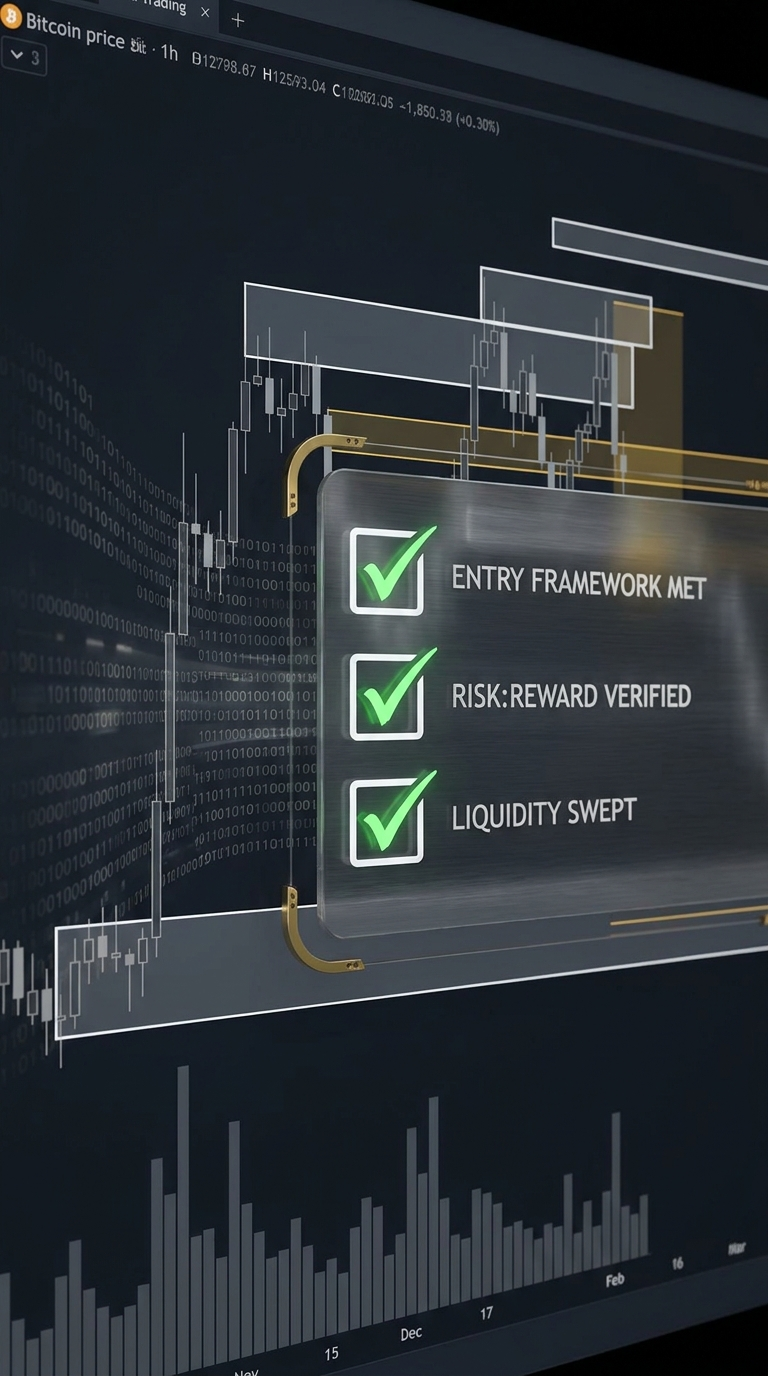
The most destructive force in your crypto portfolio is not market volatility. It is the silent, incremental friction of your own cognitive biases. I have seen countless retail traders build theoretically profitable systems, only to dismantle them live in the market through hesitation, fear, and impulsive greed.
Trading failure rarely starts with a catastrophic market crash. It starts silently. A rule is bent to accommodate a "gut feeling." A stop-loss is widened because the asset "has to bounce here." This is the exact moment you transition from an operator extracting capital to a retail liquidity provider reacting to noise.
Surviving the crypto markets requires an absolute removal of discretion. To strip away emotional friction, we must abandon reactive betting and implement strict mechanical trading strategies. The objective is to replace the human element of decision-making with a cold, unyielding operational framework.
What is a Mechanical Trading Strategy? If you are asking what is mechanical trading strategy logic at its core, the definition is absolute: it is a 100% rule-based system where your entry, exit, position sizing, and risk protocols leave zero room for human discretion. You are operating as a human algorithm.
In a true mechanical trading strategy, the chart either meets your required parameters, or it does not. There is no "maybe." There is no "I think." If condition A, condition B, and condition C are present, you execute the trade. If condition C is missing, you close the terminal. You do not force a setup simply because you want exposure to the market.
We focus on building these systems because human psychology is inherently flawed when exposed to financial risk. A mechanical system acts as a barrier between your evolutionary fight-or-flight response and your capital. You are no longer predicting the future; you are simply executing a pre-defined logical sequence whenever your edge presents itself in the market.
The Mechanical Metric: • 3+ Rules Broken = High Liquidation Risk • 1-2 Rules Broken = The Breakeven Trap • 0 Rules Broken = Flawless Mechanical Execution
Understanding Market Mechanics vs. Retail Speculation To build a robust system, you must stop viewing charts through the lens of traditional retail speculation. Retail traders use lagging indicators to chase price momentum. Institutional algorithms do not care about a moving average crossover; they care about liquidity.
A true market mechanics trading strategy is built entirely around order flow and the underlying structure of the market. Price moves from an area of consolidation to an area of resting liquidity. We focus on identifying where retail stop-losses are clustered, understanding that institutional players will drive price into those zones to fill their own massive orders.
When you align your mechanical rules with a strict market mechanics trading strategy, you stop trying to predict market direction. Instead, you wait for the market to reveal its structural intent:
• Liquidity Sweeps - Waiting for retail stops to be cleared before entering. • Market Structure Shifts - Demanding lower timeframe displacement to prove institutional participation. • Order Flow Alignment - Ensuring your intraday execution aligns with the higher timeframe delivery.
This transitions your trading from a game of being "right" on a single trade to a game of statistical averages. You understand that your edge is simply a higher probability of one thing happening over another, proven over a large sample size of trades.
Implementing Mechanical Day Trading Strategies in Crypto Applying this theory intraday requires a rigid, uncompromising workflow. When developing and deploying mechanical day trading strategies, you must rely on a fixed checklist. This checklist is your business plan.
Step 1: Establish Higher Timeframe Bias — Define your directional bias based on higher timeframe market structure (e.g., Daily or 4H charts). If the higher timeframe is bullish, your mechanical rule dictates you only look for long setups. Step 2: Identify Points of Interest (POIs) — Locate specific price levels—unmitigated order blocks or fair value gaps—where you mathematically expect a structural reaction. Step 3: Wait for Execution Triggers — A mechanical rule never buys blindly at a POI. You wait for price to reach the zone and demand a specific lower timeframe confirmation, such as a 5-minute market structure shift with displacement.
🛡️ The Operational Risk Protocol: Risk Parameters: Risk precisely 1% of your account equity per trade. Never deviate. Invalidation: Place your stop-loss structurally. If price breaches that level, your thesis is factually wrong. Accept the loss immediately. Trade Management: Take partial profits at opposing liquidity pools. Move your stop to break-even only when your mechanical rules explicitly dictate it. By reducing your intraday actions to a strict checklist, you completely eliminate the cognitive load of decision-making during highly volatile crypto sessions.
The Casino Model: Shifting from Gambler to the House The ultimate goal of mechanical execution is adopting "The Casino Model." Casinos do not care if a player wins a hand of blackjack. They do not feel anxiety when a player hits a jackpot. They understand that the mathematics of the game—their edge—guarantees their profitability over a massive sample size of hands.
When you execute a tight mechanical trading strategy, you effectively become the house. You stop judging your success by the outcome of your last trade. Your only metric for success is the flawless execution of your system.
"If you take a trade that perfectly matches your criteria and it hits your stop-loss, that is a successful trade. You executed perfectly; variance simply resulted in a temporary loss. If you break your rules, take a random trade out of boredom, and it hits your take-profit, that is a failed trade. You reinforced a toxic habit that will eventually destroy your capital."
For a true mechanical trader, the ultimate performance metric is exactly 0 rules broken.
Conclusion: Build Your Trading Constitution
The transition from a reactive retail participant to a systematic operator is the final evolution of a crypto trader. It requires abandoning the ego-driven need to predict the market and embracing the boring, repetitive nature of flawless execution.
Your mechanical trading strategy is your constitution. It dictates every action you take, protecting your capital from your own psychological flaws. Stop betting. Start extracting.
If you are ready to stop bleeding capital to emotional errors and want to see how these systematic frameworks are built from the ground up, head straight to our curriculum overview.
👉 Explore the Crypto Analysis Lab Syllabus — Stream the 5 core foundational phases completely free and watch this exact mechanical logic applied to live crypto market conditions.