Market Analysis ·
Why Do Traders Overtrade? The Discipline Gap
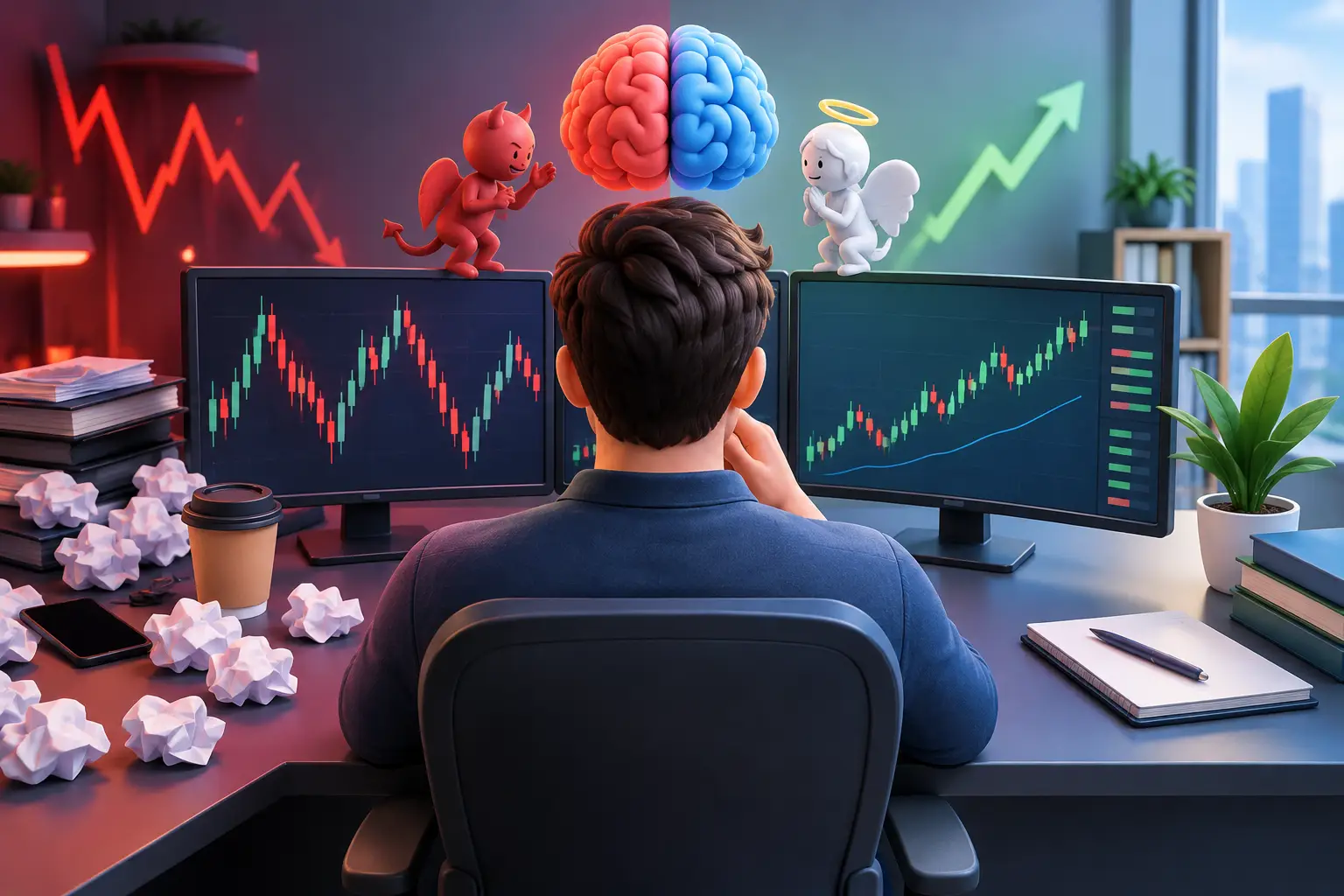
A trader marks a clean bullish market structure shift, waits for price to retrace into a defined order block, and takes a planned long. The trade ends at target. Then comes the mistake: three more entries, taken late, without a valid setup, because the trader is still chasing the feeling of being right. This is why do traders overtrade is not merely a question of bad habits. It is a question of whether execution is governed by a system or by emotion.
Overtrading is not defined only by a high number of trades. A scalper with a tested model may execute multiple valid positions in one session. A swing trader can overtrade with two impulsive entries. The real issue is taking risk outside the conditions your model was designed to exploit.
Why Do Traders Overtrade?
Most traders overtrade because the market offers constant stimulation while their rules are either unclear, untested, or easy to override. Crypto makes this pressure stronger. It trades around the clock, moves quickly, and presents an endless stream of charts, narratives, liquidations, and opinions that make inaction feel like missed opportunity.
A disciplined trader understands that not every price movement is a trade. A reactive trader interprets every movement as a chance to recover, participate, or prove a market view. That distinction separates controlled risk-taking from account-damaging activity.
The need to recover quickly
Revenge trading is one of the clearest forms of overtrading. After a loss, the trader stops evaluating the next setup on its own merits. The next trade becomes emotionally attached to the previous one. The goal shifts from executing an edge to getting back to breakeven.
This is dangerous because a loss often creates urgency, and urgency lowers standards. A trader who would normally require a liquidity sweep, displacement, market structure shift, and retracement into a point of interest may suddenly enter in the middle of a range. The setup has changed, but the position size often has not.
Losses are part of a functioning trading model. If your strategy has a 55% win rate, losses are expected even during strong execution. Treating every losing trade as a problem that must be fixed immediately turns normal variance into a destructive decision cycle.
The fear of missing the move
FOMO does not always look like buying a vertical candle. It can be subtler: entering before confirmation because price is approaching an order block, adding to a position after it has already expanded, or abandoning a preferred session because social media says a major move is underway.
The market will always produce moves you did not catch. That is not evidence that your process is failing. It is evidence that markets offer more opportunity than any single trader can responsibly take.
ICT methodology and Smart Money Concepts are useful here because they force the trader to ask specific questions. Where is liquidity resting? What is the current dealing range? Has price shown displacement? Has market structure actually shifted? Is the entry occurring at a meaningful premium or discount? If those answers are absent, the trade is usually an emotional response disguised as analysis.
Boredom and the addiction to participation
Many traders believe they need more screen time when what they need is better selection. Watching a chart for hours can create a false sense that action is required. The longer you watch minor fluctuations, the easier it becomes to assign importance to noise.
This is particularly common among traders who have not defined their trading horizon. A trader attempting to trade four-hour structure but reacting to every one-minute candle will generate contradictions. The higher-timeframe bias may remain valid while the lower timeframe creates dozens of meaningless signals.
A trading plan should tell you when not to trade as clearly as it tells you when to engage. If your model is built around the London or New York session, there is no performance advantage in forcing trades during low-quality conditions simply to stay active.
Overtrading Starts Before the Entry
The entry is visible, but the cause often begins earlier in the process. Traders overtrade when they lack a defined model, fail to measure their results, or use position sizing that makes every outcome feel personally significant.
No objective definition of a valid setup
Terms such as “good price action” or “strong momentum” are too vague to control behavior. They leave room for the mind to reinterpret the chart after every candle. Under pressure, vague rules become permission to trade anything.
A usable framework defines the sequence. For example, a trader may require higher-timeframe draw on liquidity, a sweep of internal or external liquidity, a market structure shift with meaningful displacement, and a retracement into a qualified fair value gap or order block. The precise model can vary, but the conditions must be clear enough that two chart reviews produce the same decision.
If you cannot write the conditions for entry, invalidation, and target before the trade, you do not have a setup. You have a feeling.
Position size creates emotional pressure
Oversizing and overtrading often appear together. When the risk per trade is too high, a small loss feels intolerable. The trader then seeks another setup immediately, not because it is high quality but because the emotional discomfort demands relief.
Risk management reduces this pressure. A fixed risk percentage, a maximum daily loss, and a defined number of attempts per idea create boundaries that remain in place when judgment is impaired. The exact number depends on the strategy, account size, and frequency, but it must be small enough that a loss does not change your decision-making state.
A common mistake is to set a daily loss limit but ignore a daily trade limit. These controls serve different purposes. The loss limit protects capital. The trade limit protects attention, patience, and execution quality.
Results are not being reviewed by setup type
Without data, traders tend to remember the dramatic wins and painful losses rather than the actual performance of their model. That makes them more likely to keep taking marginal trades because they cannot distinguish a valid setup from a familiar-looking one.
Journal every execution with the market context, session, setup criteria, entry location, risk, result, and whether the trade followed the plan. Then review performance by setup type. You may find that one specific pattern performs well while most losses come from entries taken before confirmation or after an initial move has already expanded.
That information is more valuable than adding another indicator. It identifies exactly where discipline breaks down.
Build a Process That Makes Overtrading Harder
Willpower is unreliable when price is moving quickly. The answer is not promising to be more disciplined tomorrow. The answer is designing a trading process that places friction between emotion and execution.
Start each session with a written directional framework. Identify the higher-timeframe dealing range, key liquidity pools, relevant order blocks, likely draw on liquidity, and the sessions in which you are willing to trade. This does not mean predicting every candle. It means knowing what evidence would justify participation.
Next, use a pre-trade checklist. Keep it short enough to use consistently, but strict enough to reject mediocre trades. Your checklist should confirm directional context, liquidity event, market structure confirmation, entry location, stop placement, target liquidity, and acceptable risk-to-reward. If a condition is missing, the trade is not ready.
Then create hard session rules. Set a maximum number of trades, a maximum daily loss, and a rule for what happens after consecutive losses. For some traders, two full-risk losses should end the session. For others, the appropriate response is reducing size or stepping away until the next defined setup. The right rule depends on your data, not on someone else's preference.
Technology can reinforce this structure when it supports rather than replaces judgment. A system such as the Antidote AI execution engine can help standardize execution and reduce impulsive deviation, but it cannot create discipline for a trader who has not defined a valid model. Automation is most useful when it enforces rules you already understand.
The Productive Alternative to Constant Trading
The goal is not to trade less for the sake of trading less. The goal is to allocate risk only when your edge is present. Some weeks will produce several clean opportunities. Other weeks will produce very few. Forcing equal activity across both conditions is a direct path to overtrading.
Professional execution often looks quiet. It includes waiting through ranges, passing on incomplete confirmations, and accepting that a missed trade is cheaper than a low-quality one. That restraint is not passivity. It is capital preservation in action.
When you feel the urge to take an unplanned trade, do not ask whether the market might move. Ask whether the setup meets your criteria and whether you would take the same trade after ten consecutive losses. If the answer is no, protect your capital, document the impulse, and wait for the market to return to your process.